When UAE homeowners and business owners start researching outdoor shade, two terms come up repeatedly: shade sails and tensile shade structures. They are related in principle but quite different in scale, engineering, and application. Understanding the distinction helps you choose the right solution for your space, budget, and performance expectations. This guide compares both options side by side, covers the materials and engineering that make them work in the Gulf climate, and helps you decide which is the better fit for your project. Whether you are shading a villa garden, a school playground, a hotel pool deck, or a commercial car park, the right tensile solution exists for that application.
Both shade sails and tensile structures use fabric under tension to create shade, and both are far more architecturally interesting than a simple flat canopy. The difference lies in how that tension is achieved, the spans that are possible, the engineering involved, and the permanence of the installation. For the full range of options, our outdoor tensile sun shade UAE service page covers every tensile solution we supply and install.
What Is a Shade Sail?
A shade sail is a flat or lightly curved panel of tensioned fabric, typically triangular or quadrilateral in shape, suspended between fixing points at its corners. The fixing points can be steel posts, building walls, or existing structures. The fabric is cut and finished with stainless steel corner rings, and tensioned by adjusting turnbuckles or cable attachments at each fixing point. The result is a taut, taught panel that shades the area beneath it while allowing air to pass around and through the weave of the fabric.
Shade sails are popular for residential gardens, pool areas, and small commercial spaces. They are relatively affordable, quick to install, and visually striking. Their main limitation is span: a single shade sail rarely exceeds 10 to 12 metres on its longest edge without requiring intermediate supports, because the tension forces at the corners become very large at greater spans. For smaller areas where aesthetics matter, shade sails are an excellent solution. For the specific application of shading a swimming pool, our premium swimming pool shades UAE page covers shade sail and tensile options designed specifically for pool environments.
What Is a Tensile Shade Structure?
A tensile shade structure is an engineered system in which fabric is held in a three-dimensional curved shape by a combination of high points, low points, and boundary cables. The curvature is not just aesthetic: it is structurally essential. A doubly-curved fabric surface is inherently stiff against wind loads in a way that a flat panel is not, which is why proper tensile structures can span far greater distances and withstand significantly higher wind speeds than a simple shade sail.
Tensile structures use steel masts, arches, or ring beams to create the high points that define the fabric form. The fabric is cut in patterns that, when tensioned into position, produce the intended three-dimensional shape. The engineering behind a large tensile structure is sophisticated: the fabric tension, mast loads, foundation requirements, and wind performance all need to be calculated by a structural engineer. In the UAE, larger tensile structures typically require municipality approval and engineering certification before installation can proceed.
Shade Sail vs Tensile Structure: Key Differences
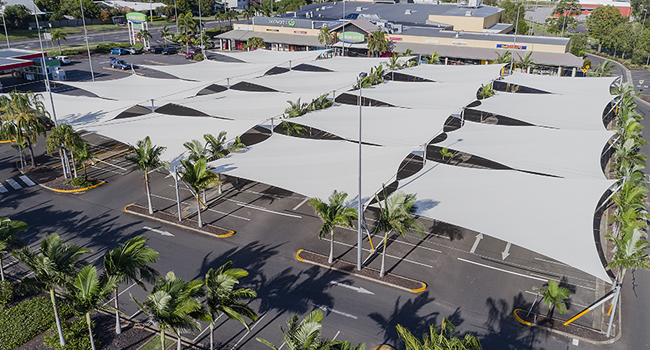
Span and coverage: Shade sails work well up to around 10 to 12 metres. Tensile structures routinely cover 20 to 50 metres or more and can shade entire car parks, school playgrounds, or hotel pool decks from a single structure. For large-scale car park shading, our car parking shades UAE page shows both shade sail and large-span tensile options.
Engineering complexity: A shade sail installation is relatively straightforward. Post sizes, foundation depths, and fabric specifications are well understood for standard spans. A large tensile structure requires structural engineering calculations, wind tunnel testing on some larger projects, and professional installation by a team with specialist equipment.
Cost: Shade sails are more affordable per square metre covered than engineered tensile structures. A quality shade sail installation for a residential space might cost AED 3,000 to 10,000 depending on size and number of sails. A large tensile structure for a school or commercial facility starts from AED 50,000 and can reach several hundred thousand for the largest spans.
Visual impact: Both create striking overhead forms, but tensile structures have a more architectural quality that suits commercial and landmark applications. Shade sails have a more relaxed, residential feel that suits gardens, pool areas, and outdoor dining spaces.
Fabric Options for UAE Shade Sails and Tensile Structures
The fabric is the most critical component of any tensile shade system. In the UAE, the combination of intense UV radiation, high temperatures, occasional strong winds, and salt air demands materials that are specifically engineered for these conditions.
HDPE (High-Density Polyethylene) is the most widely used material for both shade sails and tensile structures in the region. UV-stabilised HDPE blocks 90 to 97 percent of UV radiation while allowing air to circulate through the weave, which prevents heat build-up beneath the fabric. It is available in a wide range of colours, carries a ten-year UV warranty from quality manufacturers, and is relatively cost-effective. It is the standard specification for school playgrounds, car parks, and residential shade sails.
PVC-coated polyester is a heavier, stronger fabric used in engineered tensile structures and in applications that require complete waterproofing. It does not allow air to pass through, which means heat management needs to be considered in the structural design, but it provides full weather protection and is available in a wide range of colours and translucencies. It is the specification of choice for large commercial tensile structures. Our louvre shading and tents UAE page covers large fabric tent structures that use PVC polyester for full weatherproofing.
Tensile Shade for School Playgrounds and Sports Areas
Schools across the UAE are required to provide shaded outdoor space for students, and tensile shade structures are the standard solution for playground and sports area shading. Large-span structures can cover an entire playground from a small number of high masts, leaving the play area completely free of columns at ground level. The UAE Ministry of Education and local municipalities have specific requirements for school shade structures, including minimum shade levels, wind load certification, and fixing specifications.
If you are managing a school or educational facility, our blog on school shade UAE covers the specific requirements, design considerations, and approval process for educational settings in detail.
Maintenance and Lifespan
A quality shade sail or tensile fabric panel in the UAE will typically last eight to twelve years before the fabric needs replacing, depending on the material specification, the colour (darker colours absorb more UV and degrade slightly faster), and the care taken during installation. The structural steel components, if correctly galvanised and powder-coated, will outlast the fabric by many years and the posts can be reused when the fabric is replaced.
Annual inspection of tensioning points, hardware, and fabric condition is recommended. Fabric should be cleaned periodically with clean water and a soft brush to remove dust and organic deposits. During any rare periods of very strong wind, shade sails in particular benefit from being de-tensioned and removed temporarily if conditions exceed their design wind speed. A reputable installer will specify the design wind speed at the time of installation so you know the parameters of your structure.
Choosing the Right Tensile Shade Solution for Your Project
For most residential gardens, pool areas, and small commercial outdoor spaces, a quality shade sail installation delivers excellent shade, attractive appearance, and good value. If you are covering a large area, need engineering certification, or want a structure that will anchor the architectural character of a commercial space, a properly engineered tensile structure is the right choice. Many projects use both: a large tensile structure over the main area and smaller shade sails over seating or landscaping zones.
If you are also considering a pergola for a covered garden room alongside tensile shade for a larger outdoor area, our pergola installation UAE page covers the full range of pergola solutions that complement tensile shade across a property. For balcony and apartment spaces where a full tensile structure is not feasible, our guide on balcony and terrace shade solutions for UAE apartments and villas covers the compact options available.
Get Expert Advice on Your Tensile Shade Project
Sun Shade UAE designs and installs shade sails and engineered tensile shade structures for residential, commercial, and institutional clients across Dubai, Abu Dhabi, Sharjah, and all emirates. Our team handles everything from initial design and fabric selection through engineering certification and municipality approvals to professional installation and commissioning. Visit our services page to see what we offer, or contact us today for a free site survey and no-obligation quotation.