
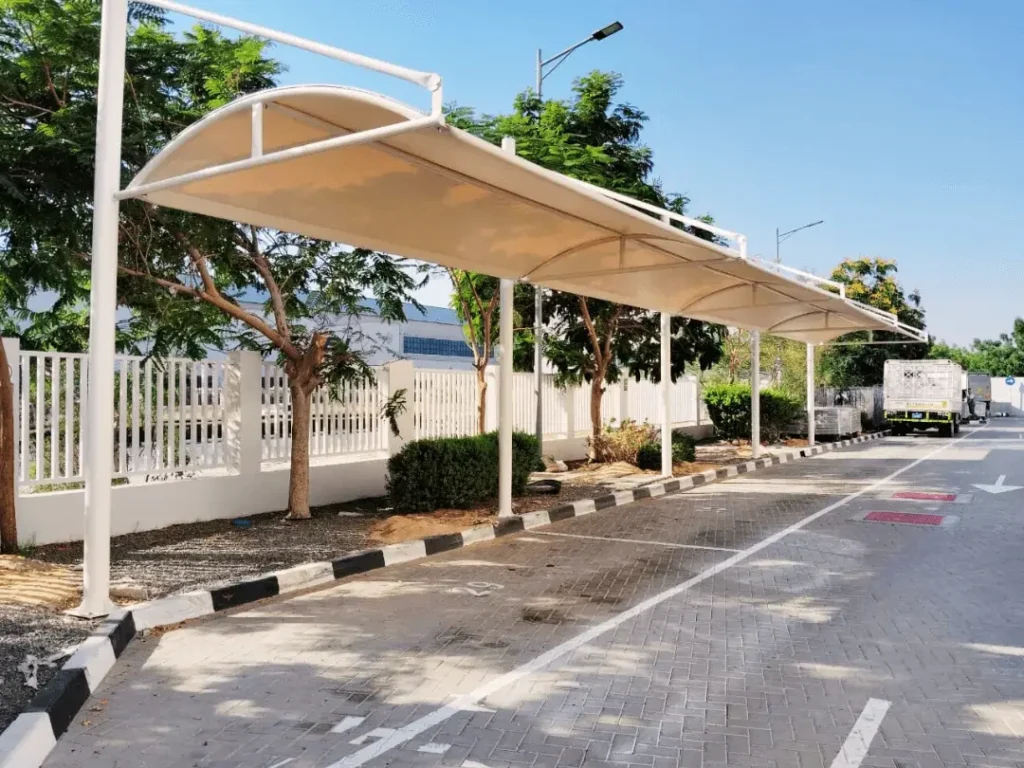
Permit requirements for car parking shades UAE wide are not identical across every emirate or even every community. This overview covers what typically applies where, though always confirm current requirements with your specific authority before starting a project.
Commercial vs Residential Requirements
Commercial car parking shade installations across nearly every emirate require a municipality permit involving structural drawings and calculations submitted for approval before work begins. Residential villa installations more often follow community-specific design guidelines rather than a municipality permit, particularly within gated communities managed by a homeowners association or master developer.
Dubai Municipality Requirements
Commercial projects in Dubai typically need structural calculations and drawings submitted to Dubai Municipality, with approval times varying based on project complexity and current submission volume. Working with a supplier experienced in this specific submission process generally speeds up approval compared to a first-time applicant navigating the requirements independently.
Abu Dhabi Department of Municipalities and Transport
Abu Dhabi’s equivalent authority follows a broadly similar structural review process for commercial installations, though specific submission formats and required documentation can differ from Dubai’s process. Projects spanning both emirates should not assume a Dubai-approved design automatically satisfies Abu Dhabi’s requirements without separate submission.
Sharjah and the Northern Emirates
Sharjah Municipality manages commercial permits similarly to Dubai and Abu Dhabi, while Ajman, Ras Al Khaimah, Fujairah, and Umm Al Quwain each have their own local municipal authority with broadly comparable, though not identical, structural review requirements.
Community Design Guidelines vs Government Permits
Many villa communities across the UAE maintain their own design guidelines covering approved colours, maximum heights, and acceptable materials for car parking shades, entirely separate from any government permit process. These community rules are just as important to follow, since non-compliance can require an expensive redesign even without any municipality involvement at all.
What Documentation to Keep
- Approved permit documentation for any commercial installation
- Structural calculations and drawings used for the approval submission
- Written confirmation of community design guideline compliance for villa installations
- Warranty documentation referencing the approved specification
Frequently Asked Questions
Do all car parking shades need a permit?
No, most residential villa installations follow community guidelines rather than requiring a government permit, though commercial installations generally do require one.
How long does permit approval typically take?
This varies significantly by emirate and project complexity, but working with a supplier experienced in the specific submission process for your location generally results in a smoother, faster approval.
Who is responsible for obtaining the permit?
Most established suppliers manage the permit process on the client’s behalf as part of the overall project, though this should be explicitly confirmed and included in the contract.
Regulations can shift over time, so always confirm current requirements for your specific location before finalising a design. See our full guide to car parking shades UAE wide, covering every major structure type and emirate.
What Happens Without Proper Permits
Installing a commercial car parking shade without required municipality approval risks a stop-work order, fines, or in some cases a requirement to dismantle the structure entirely, none of which are worth the time saved by skipping the submission process. For residential projects breaching community guidelines, the consequence is usually a formal notice requiring the structure to be brought into compliance, which can mean an expensive redesign.
How Suppliers Typically Manage the Permit Process
Established suppliers usually have existing relationships and familiarity with each emirate’s specific submission requirements, which meaningfully speeds up approval compared to a client submitting independently for the first time. This experience is one of the less visible but genuinely valuable services a good supplier provides as part of an overall project.
Frequently Asked Questions
What information does a typical permit submission require?
Structural drawings, engineering calculations for the specific wind load rating, and site plans showing the proposed structure’s location are standard requirements across most emirates for commercial submissions.
Do permit requirements change over time?
Yes, regulations can be updated periodically, so always confirm current requirements with your specific municipality or community management rather than relying solely on information from a previous project.
Is there a cost associated with permit submission?
Most municipalities charge a submission or review fee, the amount varying by emirate and project scope, which is typically included in a supplier’s overall project quotation.
Confirming the correct requirements for your specific location and project type before starting avoids costly complications partway through construction.
Staying Current With Regulatory Changes
Because permit requirements can be updated periodically across different emirates, it is worth confirming current rules directly with the relevant authority or an experienced local supplier before finalising any project, rather than relying entirely on information from a previous installation that may now be outdated.
Building a Relationship With Local Authorities
For property owners or developers planning multiple projects over time, building familiarity with the specific requirements and typical processing times of your local municipality pays dividends on every future submission. Suppliers who work regularly in a specific emirate develop exactly this kind of familiarity, which is another practical reason to favour an experienced local supplier for any project requiring permit approval.
Keeping Community Guidelines Current
Community design guidelines can be updated by a homeowners association or master developer over time, so even property owners who confirmed compliance years ago should recheck current guidelines before adding or replacing a shade structure, rather than assuming the original approval remains valid indefinitely.
A Final Word on Compliance
Treating permit and community guideline compliance as a core part of project planning, rather than an afterthought to handle once construction is already underway, consistently produces a smoother, faster, and less costly path to a finished, fully approved structure.
Getting Expert Guidance When Needed
If navigating permit requirements feels overwhelming, particularly for a first commercial project, an experienced supplier familiar with your specific emirate can walk through the exact submission process step by step, removing much of the uncertainty that makes this stage feel more complicated than it actually needs to be. Most established suppliers include this guidance as a standard part of their service rather than charging separately for it.
Getting compliance right from the outset remains the simplest, least costly path to a finished structure everyone involved can be genuinely satisfied with.
One More Consideration: Insurance Implications
An unpermitted commercial structure can sometimes complicate property insurance claims if damage occurs, since insurers may question whether the structure was legally compliant at the time of an incident. Ensuring proper permits are in place protects not just against municipal enforcement action but also against potential complications with insurance coverage down the line.
Keeping Documentation for Future Reference
Once a permit is approved and installation completed, store copies of all approval documentation somewhere easily accessible, since future property transactions, insurance reviews, or additional construction nearby may require proof of compliance years after the original installation.
A little care taken with paperwork at the start of a project consistently saves far more time and expense than dealing with a compliance issue after construction is already complete.
Whether you are a first-time villa owner or an experienced developer, the same principle applies everywhere in the UAE: confirm requirements before construction begins, not after.
Getting this one step right at the outset removes a source of risk that otherwise lingers over a property for as long as the structure stands.
Confirming these details before construction begins, rather than after, is the single most reliable way to protect the entire project from unnecessary delay.